 1641b4aba5
Follow-up to #9507, carrying over the reset-credit redemption from #9421. Codex grants a reset credit when it has rate-limited an account unfairly (`"Thanks for using Codex! You've been granted one free rate limit reset."`). Redeeming one clears the current 5h/weekly windows. The Limits tab now shows how many are banked and when the next expires, with a confirmed **Use a reset credit** action. ## How it works - `ServerProviderUsageLimits.resetCredits` carries the count and soonest expiry; the Codex probe reads it from the same `account/rateLimits/read` it already makes. - `ProviderInstance.consumeResetCredit` is a new optional hook — account-level, so it sits beside `refreshModels` rather than on the thread-routed adapter. The Codex driver implements it over a short-lived app-server (via `withCodexAppServerClient`, factored out of the status and skills probes which duplicated the setup), then re-probes. - Single-flight per instance with one idempotency key kept until Codex reports an outcome, so a retry after a timeout does not open a second attempt. - New `provider.consumeResetCredit` RPC under the operate scope; the outcome (`reset` / `nothingToReset` / `noCredit` / `alreadyRedeemed`) is shown inline. Only Codex reports credits today. A provider without the hook gets a clear "does not bank reset credits" error; one without credits shows nothing. ## Screenshots The local Codex row with one banked credit (the same account via the CLIProxyAPI hub above it shows no credit, as expected — the hub does not relay them): 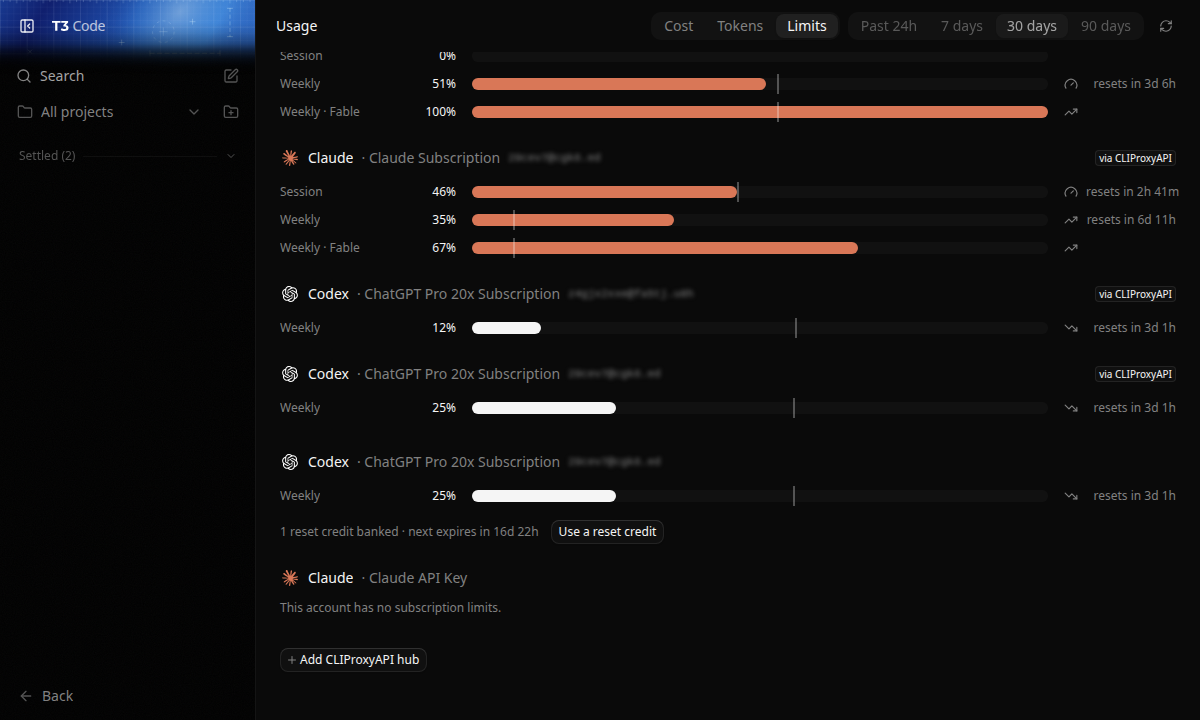 Close-up of the row:  Clicking it opens the confirmation; nothing is sent until **Use credit**: 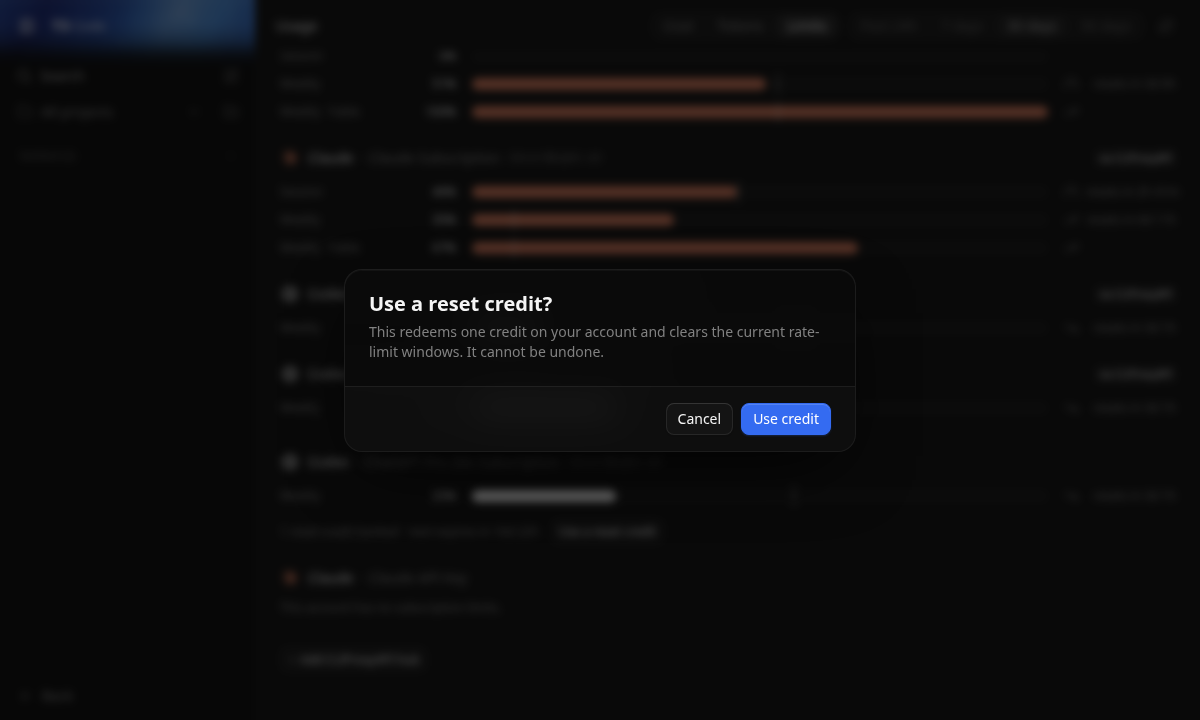 ## Verification - Mapper tests for the credit summary; provider, contract, and Usage page suites pass; typecheck clean. - Verified against a real Codex Pro account holding one credit: summary and expiry render, the confirm dialog opens. **Not redeemed** — that would spend the credit. Written by Claude Fable 5 via Claude Code; design and single-flight approach from @StiensWout's #9421. <!-- CURSOR_SUMMARY --> --- > [!NOTE] > **Medium Risk** > Redemption spends real account credits over a new RPC; correctness depends on per-account locking and idempotency, though disabled instances and non-Codex providers are rejected explicitly. > > **Overview** > Adds **end-to-end redemption of banked Codex rate-limit reset credits** from the Limits UI on web and mobile, backed by a new operate-scoped `provider.consumeResetCredit` RPC. > > **Contracts and server:** `ServerProviderUsageLimits` can include `resetCredits` (count + next expiry). Codex probes attach that from `account/rateLimits/read`. Optional `ProviderInstance.consumeResetCredit` is implemented for Codex via a scoped app-server call to `account/rateLimitResetCredit/consume`, then a limits refresh. `CodexResetCreditCoordinator` serializes redemptions per Codex account directory, reuses one idempotency key until Codex returns an outcome, and times out hung requests. `withCodexAppServerClient` is extracted so status, skills, and redemption share the same short-lived app-server setup. > > **Clients:** Limits rows show banked credits and a confirmed **Use a reset credit** action that calls `serverEnvironment.consumeResetCredit` and surfaces outcomes (`reset`, `nothingToReset`, etc.) or errors. > > **Web usage sources (same PR):** Adding/removing CLIProxyAPI hubs and the add dialog target a **selected connected environment** (with picker when several are connected), gated by operate access—not only the primary environment. > > <sup>Reviewed by [Cursor Bugbot](https://cursor.com/bugbot) for commit 98f32e60852dca1d38c94335b3ed7aac8c4b895e. Bugbot is set up for automated code reviews on this repo. Configure [here](https://www.cursor.com/dashboard/bugbot).</sup> <!-- /CURSOR_SUMMARY --> Co-authored-by: Wout Stiens <[email protected]> Co-authored-by: Claude Code <[email protected]>



Client Runtime
Shared client behavior for web and mobile. Public APIs are organized by package subpath. The package intentionally has no root export.
Public subpaths
| Subpath | Responsibility |
|---|---|
authorization |
Bearer and DPoP authorization plus token persistence contracts |
connection |
Targets, catalog, supervision, retries, registry, and onboarding |
environment |
Environment identity, descriptors, endpoints, and scoped keys |
errors |
Shared client error inspection |
operations |
Multi-step application workflows |
operations/projects |
Multi-step project creation workflows |
platform |
Platform capability and persistence service contracts |
relay |
Managed relay API and environment discovery |
rpc |
HTTP/RPC clients, protocol, sessions, and subscriptions |
state/<domain> |
Focused shared state, retention, reducers, and Atom constructors |
voice-input |
Recording lifecycle, transcription contracts, and draft insertion |
Dependency direction
Platform applications provide platform services. connection composes those
capabilities with authorization, relay, and rpc to supervise environment
sessions. Independent state modules consume the connection registry and expose
focused state or Atom constructors to application-owned runtimes.
The voice-input controller accepts capture callbacks and a selected VoiceTranscriber.
Preparation binds transcription to its implementation and resolved locale; one cancellation
signal covers both operations. Applications provide recorder events, permissions, native
transcription implementations, and presentation.
Applications should import the narrowest relevant subpath. There is no broad
state export: use domain paths such as state/shell, state/threads,
state/terminal, or state/vcs. Subpath indices and explicitly exported domain
files are public API boundaries; all other files remain implementation details.