Long runs display total minutes, such as `419m 50s`, which is hard to read.

Show `6h 59m 50s` instead. Web, desktop, and mobile use the shared formatter for long live, completed, and stopped runs.

## Verification

- 210 tests pass with `vp test run packages/shared/src/orchestrationTiming.test.ts apps/web/src/components/chat/MessagesTimeline.logic.test.ts apps/mobile/src/lib/threadActivity.test.ts`.
- Shared, web, and mobile typechecks pass.
- Changed-file lint and formatting pass, with existing lint warnings.
- Browser verification and screenshots skipped at Theo's request.

Created with GPT-6 Astra (preview) in Codex.
Restore status feedback, code-view worker reuse, streaming highlighting recovery, safe outbox recovery, current HTML, and projected live-event budgets.

Verified with browser checks, iOS outbox recovery, 281 focused tests, and full CI. CI uses Shivam's HTTPS mirror fix.

Created with GPT-6 Astra (preview) in Codex.

Co-authored-by: shivam <[email protected]>
Bound cached parsed review sections by eight entries and 4,194,304 full source characters. Evicted inactive parsed and native results can be collected. Raw patches, comments, and view state stay unchanged.

Prewarm only nearby sections that fit beside the selected section. Use actual retained source weights for normalized cache hits, and skip oversized prewarms.

Created with GPT-6 Astra (preview) in Codex.
Accept file-backed image drafts and v4 outbox records while keeping current inline image creation and v3 outbox writes.

Retain image files during previews, uploads, and legacy inline reads. Preserve image MIME types and stop canceled sends after asynchronous reads.

The later file-backed writers remain held until new native runtime fingerprints contain these readers and the storage guards.

Continue Wout Stiens' mobile draft work with separate reader-only corrections. The original contribution remains unchanged.

Created with GPT-6 Astra (preview) in Codex.

Co-Authored-By: Wout Stiens <[email protected]>
Co-Authored-By: Claude Fable 5 <[email protected]>
Keep bounded, byte-counted terminal chunks and append only unread output. Use UTF-16 cursors so compaction preserves live terminal replies. Reset on lifecycle changes or a real retained-data gap.

Keep the existing wire protocol, native buffer interface, and client retention limit. Native streaming and strict server replay byte bounds remain separate.

Continue the client helpers from https://github.com/pingdotgg/t3code/pull/9027 at source head 9391da2b48439d1d7a2b01d169e785682bf8abb8.

Created with GPT-6 Astra (preview) in Codex.

Co-Authored-By: Wout Stiens <[email protected]>
Co-Authored-By: Claude Fable 5 <[email protected]>
OpenCode could show an Approval badge with no controls, appear stuck on TodoWrite, and keep showing a running turn after Stop.
- Show every permission, including old saved requests. Keep failed replies retryable and close completed requests even when reply events are lost.
- Keep OpenCode output pipes drained and automatic replies out of the event loop. Handle disconnects, reconnects, and confirmed stops without stale requests or running states.
- Show native task progress and command results. Do not treat TodoWrite or approval history as file edits or executed commands.
- Ignore late aborts and task updates after a turn finishes.
Fixes#4795Fixes#7113Fixes#5760
Created with GPT-6 Astra (preview) in Codex. Reviewed and merged with Claude Fable 5.1 in Claude Code.
Follow-up to #9507, carrying over the reset-credit redemption from #9421.
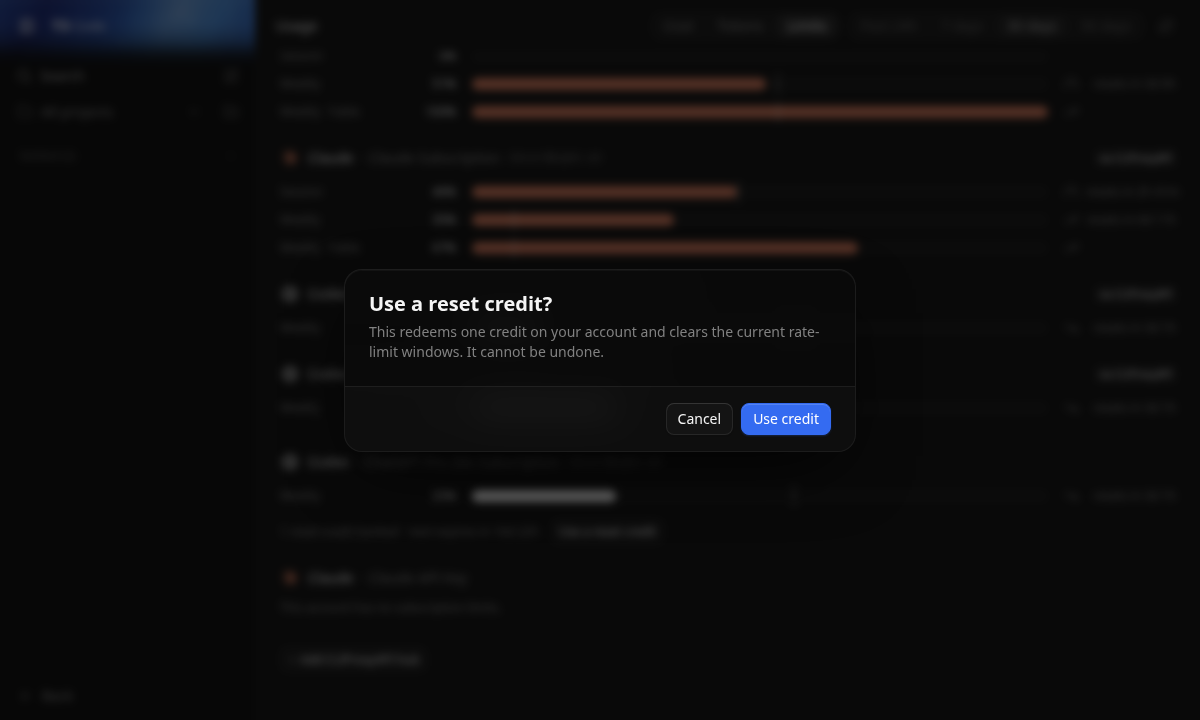
Codex grants a reset credit when it has rate-limited an account unfairly (`"Thanks for using Codex! You've been granted one free rate limit reset."`). Redeeming one clears the current 5h/weekly windows. The Limits tab now shows how many are banked and when the next expires, with a confirmed **Use a reset credit** action.
## How it works
- `ServerProviderUsageLimits.resetCredits` carries the count and soonest expiry; the Codex probe reads it from the same `account/rateLimits/read` it already makes.
- `ProviderInstance.consumeResetCredit` is a new optional hook — account-level, so it sits beside `refreshModels` rather than on the thread-routed adapter. The Codex driver implements it over a short-lived app-server (via `withCodexAppServerClient`, factored out of the status and skills probes which duplicated the setup), then re-probes.
- Single-flight per instance with one idempotency key kept until Codex reports an outcome, so a retry after a timeout does not open a second attempt.
- New `provider.consumeResetCredit` RPC under the operate scope; the outcome (`reset` / `nothingToReset` / `noCredit` / `alreadyRedeemed`) is shown inline.
Only Codex reports credits today. A provider without the hook gets a clear "does not bank reset credits" error; one without credits shows nothing.
## Screenshots
The local Codex row with one banked credit (the same account via the CLIProxyAPI hub above it shows no credit, as expected — the hub does not relay them):
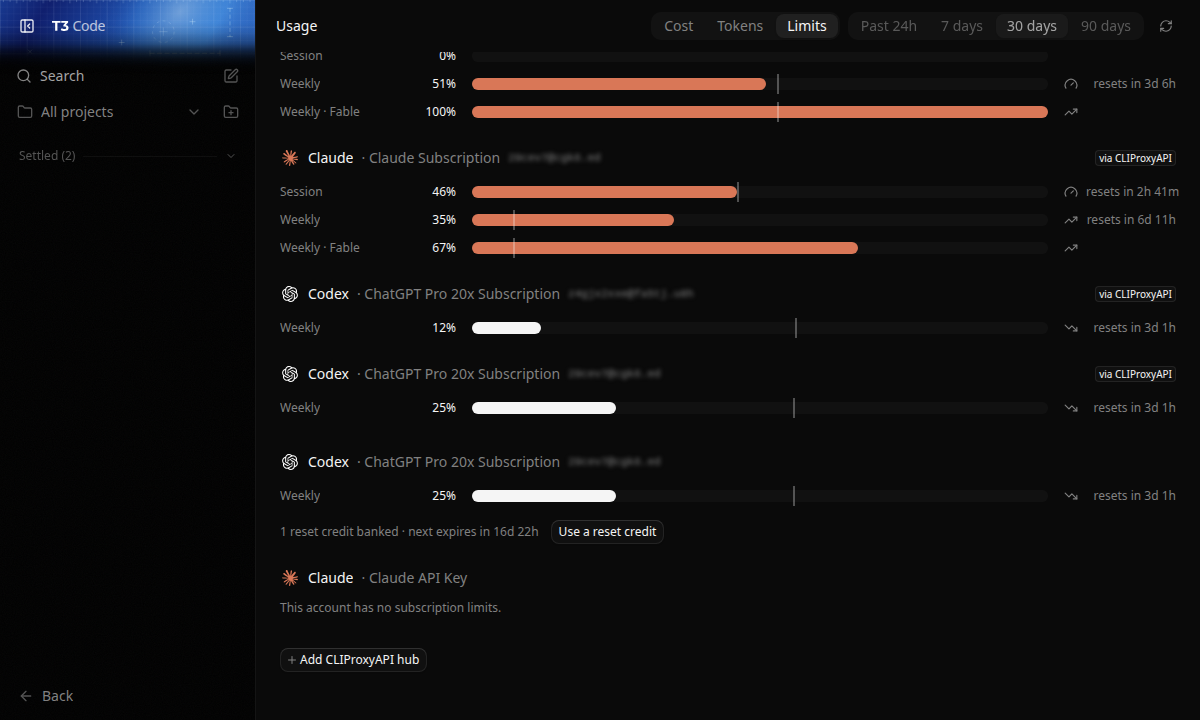
Close-up of the row:

Clicking it opens the confirmation; nothing is sent until **Use credit**:
## Verification
- Mapper tests for the credit summary; provider, contract, and Usage page suites pass; typecheck clean.
- Verified against a real Codex Pro account holding one credit: summary and expiry render, the confirm dialog opens. **Not redeemed** — that would spend the credit.
Written by Claude Fable 5 via Claude Code; design and single-flight approach from @StiensWout's #9421.
<!-- CURSOR_SUMMARY -->
---
> [!NOTE]
> **Medium Risk**
> Redemption spends real account credits over a new RPC; correctness depends on per-account locking and idempotency, though disabled instances and non-Codex providers are rejected explicitly.
>
> **Overview**
> Adds **end-to-end redemption of banked Codex rate-limit reset credits** from the Limits UI on web and mobile, backed by a new operate-scoped `provider.consumeResetCredit` RPC.
>
> **Contracts and server:** `ServerProviderUsageLimits` can include `resetCredits` (count + next expiry). Codex probes attach that from `account/rateLimits/read`. Optional `ProviderInstance.consumeResetCredit` is implemented for Codex via a scoped app-server call to `account/rateLimitResetCredit/consume`, then a limits refresh. `CodexResetCreditCoordinator` serializes redemptions per Codex account directory, reuses one idempotency key until Codex returns an outcome, and times out hung requests. `withCodexAppServerClient` is extracted so status, skills, and redemption share the same short-lived app-server setup.
>
> **Clients:** Limits rows show banked credits and a confirmed **Use a reset credit** action that calls `serverEnvironment.consumeResetCredit` and surfaces outcomes (`reset`, `nothingToReset`, etc.) or errors.
>
> **Web usage sources (same PR):** Adding/removing CLIProxyAPI hubs and the add dialog target a **selected connected environment** (with picker when several are connected), gated by operate access—not only the primary environment.
>
> <sup>Reviewed by [Cursor Bugbot](https://cursor.com/bugbot) for commit 98f32e60852dca1d38c94335b3ed7aac8c4b895e. Bugbot is set up for automated code reviews on this repo. Configure [here](https://www.cursor.com/dashboard/bugbot).</sup>
<!-- /CURSOR_SUMMARY -->
Co-authored-by: Wout Stiens <[email protected]>
Co-authored-by: Claude Code <[email protected]>
Users on Codex or Claude Code subscriptions could not see how much quota was left or when it resets without leaving T3 Code. A user whose CLIs route through a CLIProxyAPI hub could not see it at all.
Each driver now returns `usageLimits` on its own snapshot (Codex from `account/rateLimits/read`, Claude from the SDK's `get_usage`), adapters normalise turn-driven rate-limit events at the boundary, and a driver-blind ingestion layer folds them onto the owning instance. The Usage page gains a Limits tab (mobile a card) with a bar per window, elapsed marker, pace, and reset countdown. CLIProxyAPI hubs can be added as read-only usage-limit sources; their accounts show badged "via CLIProxyAPI" with emails blurred.
Distilled from #1732 (server model, provider rows) and #9421 (Limits tab, window bars, pace maths). Closes#228.
Co-authored-by: Aditya Mer <[email protected]>
Co-authored-by: Wout Stiens <[email protected]>
Co-authored-by: Claude Code <[email protected]>



